What to Expect When You Commission Custom Furniture (Process, Timeline & Cost)
Here's exactly what happens when you commission custom furniture — from first email to delivery. Timelines, deposits, and honest answers from Wood Chaser, Omaha, NE.
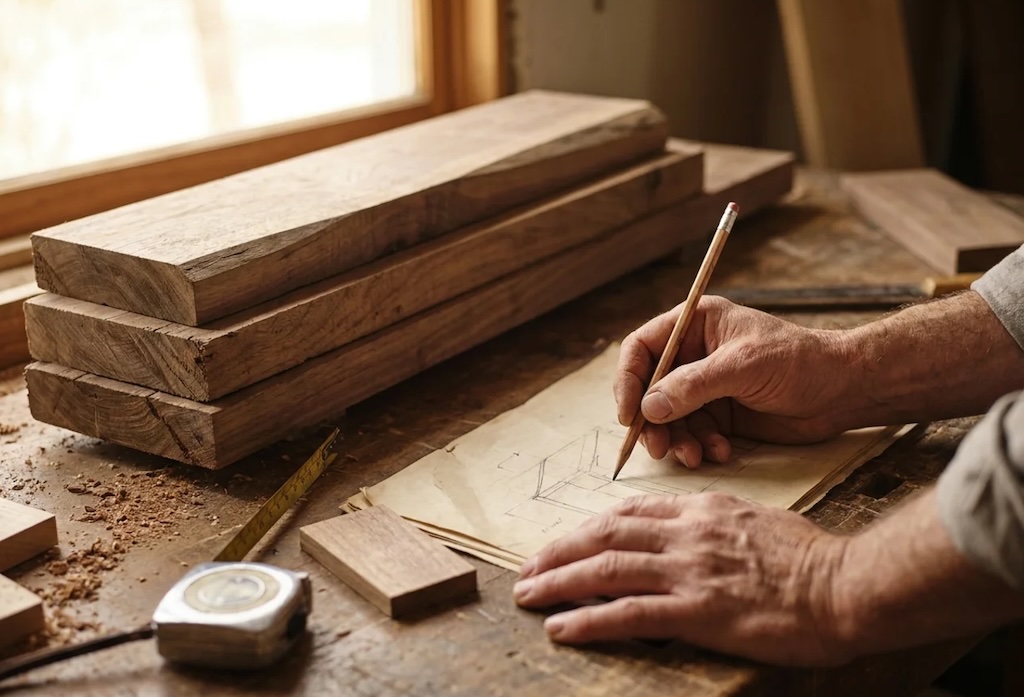
WHAT TO EXPECT WHEN YOU COMMISSION CUSTOM FURNITURE
Commissioning custom furniture feels, to a lot of people, like a mysterious process. You email a stranger with a vague idea, something, something money, and then months later, a beautiful object shows up at your door? That can't be how it works, right?
Turns out, it's pretty close to how it works. But I think the whole thing is less intimidating — and more fun — when you know what the steps actually look like. So here's a walkthrough of what happens when you decide to have something made, start to finish.
STEP 1: THE FIRST CONVERSATION
This is usually a few emails, a phone call, or a coffee if you're local. You tell me what you're thinking about. It doesn't have to be a polished pitch. "I need a dining table for eight people, my wife wants something not-too-modern, here are three photos I screenshotted at 11 pm" is a totally valid starting point.
The things that help me most at this stage:
- Dimensions. Even rough ones. How big is the space? How much clearance do you need?
- Photos. Of the room the piece is going into, other furniture that'll live near it, and any inspirational images you like.
- Use case. Who's using it, how often, and for what?
- Budget. I know people hate sharing this. I promise I'm not trying to pry — I'm trying to match the build to what you want to spend. Telling me a range (even a wide one) helps me propose options that make sense instead of ones that don't.
- Timeline. Do you need this for a specific event, or is "sometime in the next several months" fine?
You don't need to have answers to all of these. Gaps are normal. We figure them out together.
STEP 2: THE PROPOSAL
Once I've got a sense of what you're after, I'll put together a proposal. This usually includes a rough sketch or two, a wood recommendation, approximate dimensions, a finish recommendation, and a price.
A few things worth knowing about this step:
The sketch is not the final design. It's a starting point to make sure we're pointed in the same direction. Your reaction — "yes, that's it," or "I was picturing legs more like this," or "can we make it six inches shorter" — is exactly what I need to refine things.
The price is real. I don't love the "starting at" games some makers play. When I quote you a number, that's the number, assuming the scope we agreed on. If things change mid-build, we have a conversation about it before anything happens. No surprise invoices.
It's okay to say no. If the proposal isn't right — too expensive, wrong direction, you've decided to go a different way — just tell me. I'd rather hear a clear "not right now" than have the thread go quiet. And I'm happy to revise, rescope, or point you toward a better fit elsewhere.
STEP 3: DESIGN AND MATERIALS
Once we agree on direction, this is where things get more detailed. I'll firm up dimensions, pick out the actual boards from my lumber stock (or order specific ones if we need something special), and work through the construction details. For bigger pieces, I'll often send you a more detailed drawing or a 3D model so you can see exactly what's coming.
This is also when I take a deposit — typically 50% — which covers materials and reserves your spot in the queue. The balance is due when the piece is done.
STEP 4: THE BUILD
This is the part where I disappear into the shop for a while. Depending on the piece, a build can take anywhere from a couple of weeks to a couple of months. A nightstand is fast. A large dining table with hand-cut joinery is not fast.
I'll send you occasional photos during the build — not because I'm trying to pad your inbox, but because most clients genuinely enjoy seeing a pile of rough boards turn into the thing they ordered. If you'd rather not see updates and prefer to be surprised, tell me, and I'll keep quiet until it's done.
A few things that can shift timing during this stage:
- Wood behavior. Wood moves. Sometimes a board reveals a defect when you mill it that it didn't show on the outside. If I need to swap material, I'll let you know.
- Finishing time. Finishes need time to cure. A rushed finish now is a ruined finish in two years. I won't cut corners here.
- Life stuff. Occasionally, someone else's project hits a snag and pushes things a bit. I try hard to keep to the schedule, and I'll give you honest updates if anything slips.
STEP 5: DELIVERY
When the piece is done, we figure out delivery together. For local clients, I often deliver and install personally — partly because I like seeing the piece in its new home, and partly because it's the safest way to move something I've just spent weeks making. For farther clients, I work with furniture-specific shippers who actually know how to handle finished pieces (not the kind of shipping that involves a truck full of cardboard boxes).
When the piece arrives, I'll walk you through care (or leave a care sheet), and we'll do a final look-over together to make sure you're happy. If something's off, tell me — I'd much rather fix it than have you quietly live with something that isn't right.
STEP 6: THE REST OF ITS LIFE
Good furniture has a long life. I stand behind what I make — if a joint ever fails, or a finish needs refreshing years down the road, get in touch and we'll sort it out. I also keep notes and photos on every commission, so if you want a matching piece made in three years, I can usually pick up right where we left off.
HOW LONG DOES THE WHOLE THING TAKE?
Ballparks, assuming the queue is in a normal place:
- Small pieces (nightstands, side tables, small shelves): 3–6 weeks from go-ahead
- Medium pieces (desks, coffee tables, credenzas): 6–10 weeks
- Large pieces (dining tables, beds, built-ins): 8–14 weeks, sometimes longer
If you've got a hard deadline, tell me at the start. I can usually find a way to make it work, or be honest that I can't, before we're three weeks in.
THE SHORT VERSION
Commissioning a custom piece isn't a black box. It's a conversation, a plan, a deposit, a build, and a delivery. The parts where you're most involved are at the beginning (figuring out what you want) and the end (living with it). The middle is mostly me in the shop, trying to make something you'll love.
If any part of this felt unclear, or if you're on the fence about whether custom is right for you, shoot me a message. Even a "is this a dumb question?" email is welcome. Woodchaser is based in Omaha, Nebraska — we build for clients locally and nationwide.
FREQUENTLY ASKED QUESTIONS
How long does it take to commission custom furniture?
Typical timelines are 3–6 weeks for small pieces (nightstands, side tables), 6–10 weeks for medium pieces (desks, credenzas, coffee tables), and 8–14 weeks for large pieces (dining tables, beds, built-ins). These are from the day materials are confirmed; if the shop queue is unusually busy, we'll let you know up front.
How much does custom furniture cost?
Custom pricing depends on size, species, complexity of joinery, and finish. Most commissioned pieces fall in a range that's competitive with good mid-to-upper-tier retail furniture but built to last significantly longer. Share your rough budget, and we'll propose options that fit; we don't do mystery "starting at" pricing.
Do you require a deposit?
Yes. We take 50% at the start of the build, which covers materials and reserves your spot in the queue. The balance is due when the piece is finished.
Can I see progress photos during the build?
Yes — most clients love getting occasional shop photos as boards get milled, joined, and finished. If you'd rather be surprised at delivery, just say so and we'll keep quiet.
Do you ship custom furniture nationwide?
Yes. For local clients in Omaha and the surrounding metro, we often deliver and install ourselves. For clients outside the region, we work with furniture-specific shippers who know how to handle finished pieces safely.
What if I don't love the piece when it arrives?
We do a walk-through together at delivery. If something isn't right, we fix it — that's the whole point of working with a maker instead of a warehouse. Small tweaks and adjustments are part of the process.