How to Choose the Right Wood for Custom Furniture (Walnut, Oak, Maple & More)
A plain-English guide to picking the right wood for your custom furniture — walnut, white oak, maple, cherry, ash. Built by Wood Chaser, custom furniture makers in Omaha, NE.
How to Choose the Right Wood for Your Custom Furniture
So you're thinking about having a piece made. Maybe it's a dining table big enough for your whole family, a bookshelf that finally fits the weird nook in your living room, or a bed frame that doesn't creak every time someone rolls over. Whatever it is, one of the first questions I'll ask when you reach out is: What kind of wood are you picturing?
And if your answer is "uhh, the brown kind?" — don't worry. That's most people. This post is for you.
Here's a friendly walkthrough of the woods I work with most often, what they're good at, and how to think about picking one without getting buried in jargon.
Start with how the piece will be used, not how it looks
I know, that sounds backwards. Most folks start with a Pinterest board. But the honest truth is that wood choice matters way more for how a piece holds up than for how it looks on day one. A dining table that gets elbows and spaghetti sauce on it eight times a week has different needs than a side table in a guest room.
Ask yourself a few things:
- Will this piece get daily, heavy use — or live a more pampered life?
- Will kids, pets, or dinner parties happen on it?
- Does it need to match existing furniture, or stand on its own?
- Is it going near a window, radiator, or a drafty spot?
Answers to those shape everything. Once we know how a piece is going to live, we can figure out what it should be made of.
The usual suspects (and when they shine)
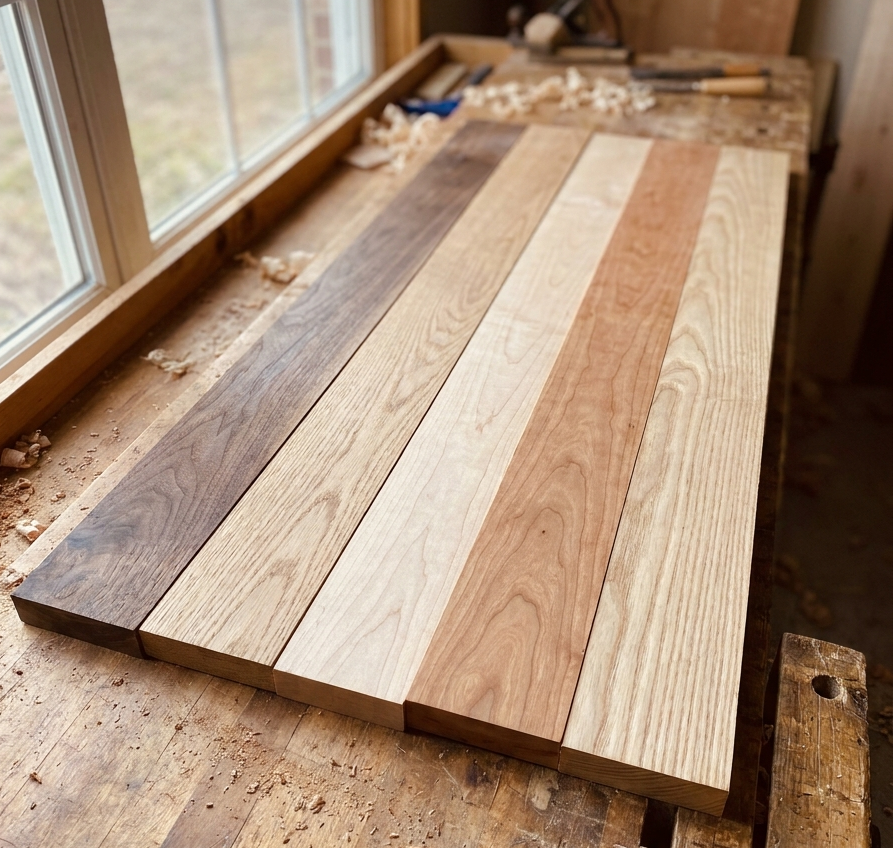
Walnut. Rich, chocolatey, a little purple in certain light. Walnut is my go-to when someone wants a piece that feels warm and grown-up without being dark-dark. It's a medium-hard wood, so it handles normal furniture life just fine. It does lighten up over years of sun exposure, which some people love and some people don't — worth knowing up front. Walnut is also on the pricier side, so it shows up more often in statement pieces than in, say, utility shelving.
White oak. The workhorse. Dense, durable, beautifully grained once you get a finish on it. White oak is what I'll usually recommend for a dining table that's going to see real life. It takes stain well if you want something darker, and it looks gorgeous left natural with a simple oil finish. If you've ever swooned over one of those warm, modern farmhouse tables, there's a strong chance it was white oak.
Maple. Lighter in color, very hard, very clean-looking. Maple is great if you want a bright, Scandinavian feel, or if you want the wood grain to take a back seat and the shape of the piece to be the star. It's not cheap, but it takes a beating — which is why a lot of cutting boards and butcher blocks are made from it.
Cherry. Starts a pale pinkish color and darkens to a deep reddish-amber over a few years. Cherry is one of those woods that actually gets better looking with age, which is a fun thing to own. A little softer than oak, so not my first pick for a surface that's going to take a lot of abuse, but wonderful for things like dressers, desks, and accent pieces.
Ash. Underrated, in my opinion. Looks a bit like oak but with a lighter, blonder tone and a pronounced grain. Strong, springy, and generally easier on the wallet than walnut or cherry. Great for chairs and anything where you want a piece that can flex a little without complaining.
There are plenty more — hickory, sapele, poplar, and so on — and I'm happy to talk through specialty picks if you have something specific in mind. But those five cover most of what I build day to day.
Softwoods are a thing too
If budget is a real constraint or the look you want is more rustic, softwoods like pine or Douglas fir can be excellent choices. They dent more easily than the hardwoods above, which some people hate and some people find charming — dents turn into patina, and patina turns into character. Just go in with eyes open. A softwood coffee table will look very different in ten years than a white oak one.
A few other things worth thinking about
Grain and figure. Two walnut boards can look surprisingly different from each other. If you have a strong preference — very straight and calm, or wild and figured with lots of movement — tell me. I pick boards for every custom build and I'd rather pick them with your taste in mind than guess.
Matching existing furniture. You don't have to match, and sometimes it actually looks better not to. A walnut dining table next to an oak sideboard can be gorgeous. That said, if matching is important, bring a photo (or better, a drawer front or small sample) and we'll work from there.
Sustainability. If this matters to you — and it matters to me — ask. I source domestically whenever I can, and I'm happy to tell you exactly where a given board came from. Some species you might see online are not great choices environmentally, and I'll steer you away from those.
Budget. Wood is often the single biggest material cost in a custom build. Shifting from walnut to white oak, or from cherry to ash, can meaningfully move the number without changing the character of the piece much. If there's a price you're trying to hit, say so — I'll tell you where the flexible levers are.
The short version
If you want me to just pick for you, I will, and it'll be great. But if you'd like to have an opinion, a good rule of thumb is:
- Heavy daily use → white oak, maple, or ash
- Warmth and character → walnut or cherry
- Tight budget or rustic vibe → pine or fir
- Something unusual → let's talk
At the end of the day, there is no wrong answer. Real wood furniture, built well, is going to outlast most of the rest of your house no matter what species you pick. The goal of the conversation is just to make sure the piece that shows up at your door is one you're going to love sitting with for the next forty years.
When you're ready, send me a message with what you have in mind — even if it's just a rough idea — and we'll go from there.